Facebook Post Ideas: 45 for Businesses, Plus a 30-Day Calendar
Written by: Tim Eisenhauer
Last updated:

The easiest way to keep your social media profiles active.
Learn more about Apaya →
What should a business post on Facebook?
Posts that do one of five jobs: prove the work is good, show the humans, answer real questions, make the offer plainly, or join the local conversation. Facebook is the platform where checking behavior is heaviest: before someone calls a plumber, books a table, or tries a new dentist, they look at the Facebook page the way a previous generation checked the parking lot. Below are 45 ideas organized by those five jobs, the fine print on engagement posts, and, because a list still leaves you deciding what to post when, a filled-in 30-day calendar you can follow as written.
The pages ranking for this search are idea lists with big numbers and no plan. Take the ideas from anywhere, ours included; the calendar at the end is the part nobody else gives you. And because ideas on a page are cheap, five of them appear below as finished posts, generated in Apaya from a one-line brief, so you can see what each type looks like leaving the building.
Turn these ideas into finished posts
Ideas are the free part; production is the grind. Apaya writes the Facebook posts in your voice, designs the graphics, schedules, and publishes, from $55/mo. You approve the calendar instead of building it.
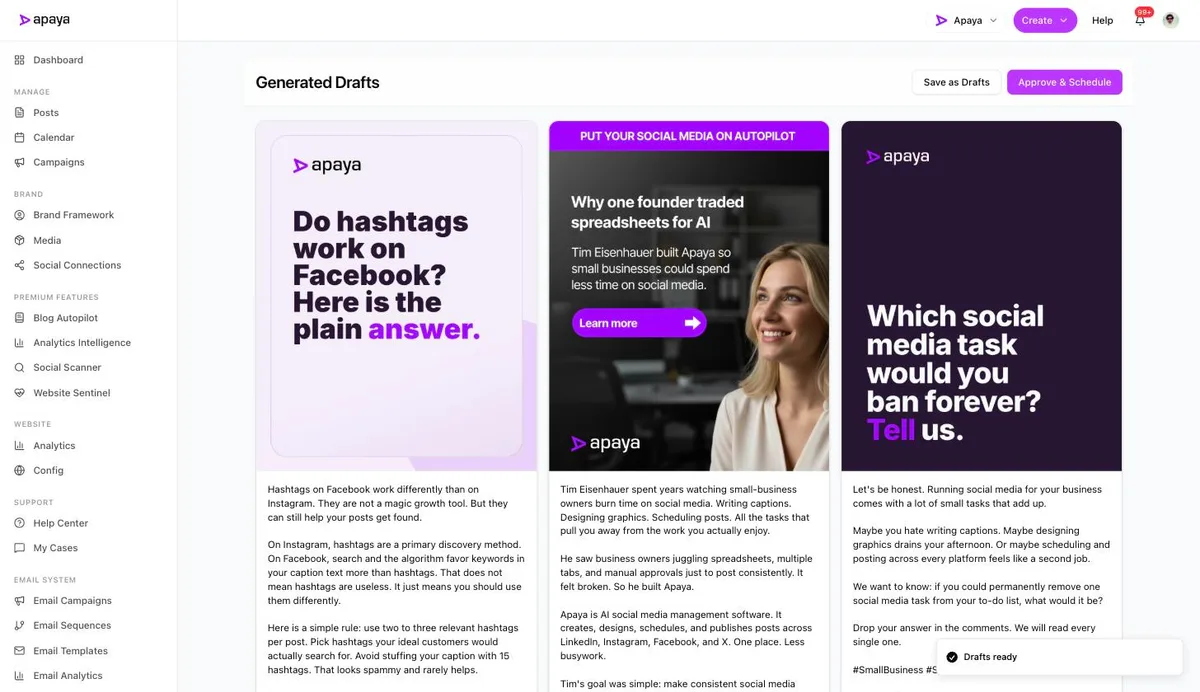
Three of the ideas below as finished posts: education (18), meet the founder (10 and 16), and the genuine question (41). Generated in Apaya from a one-line brief, graphics included.
Proof: the posts that convince a checking customer (1-9)
- The finished job. One photo, one sentence about what it took. This is the lowest-effort, highest-trust post that exists: it proves the business worked today, and a feed with a steady rhythm of finished work reads as booked and competent.
- Before and after. The single highest-converting format for visual work. Put the two images in one graphic so the swipe or squint isn’t required, and write one line about what the owner’s problem was, because the story is the before, not the after.
- The review screenshot. Reshare the review as an image with a short thank-you naming what the job was. A review in the feed reaches the people who were never going to dig through your ratings page, and thanking customers publicly teaches others to leave their own.
- The number: years in business, jobs done, five-star count.
- The save: the emergency call, the rush order, the fix for someone else’s botch.
- The process video, thirty seconds, shot on a phone.
- The detail a customer would never notice but a craftsman is proud of.
- The repeat customer: “fourth project for this family.”
- The milestone post. Years in business, the thousandth customer, the new truck. Say the number, thank the people, skip the speech. Milestones earn congratulation comments, and comments are the platform’s favorite signal.
Faces: the posts that make you knowable (10-17)
- Meet the owner. Who you are, why you do this work, one real photo. Repost a fresh version quarterly, because new followers never saw the last one and the algorithm treats it as new. The founder example in the image above is this exact idea.
- Team member spotlight, one human fact each.
- The workspace or truck tour.
- A day in the life, morning to close.
- The hiring post, even between openings; growth reads as health.
- Work anniversaries.
- Why you started this business. The real version: the job you left, the gap you saw, the first customer. Origin stories outperform because people buy from people, and this is the post that turns a logo into a person. Never invent details; the internet can tell.
- The mistake you made right. Rare and powerful, and only when true.
Education: the posts that get shared to a spouse (18-27)
- The question your front desk answered three times this week. Post the question verbatim and answer it in plain words. Demand is pre-validated (three people asked), the material costs nothing, and it compounds into a feed that answers before the phone rings. The hashtag example above is this idea in the wild.
- The myth that costs your customers money. Name the myth, say what’s true, say what believing it costs. Myth-busting earns shares because the person who just learned it wants credit for knowing it.
- How to choose someone in your trade. Include the red flags, including ones that would disqualify a cheaper competitor. Confidence reads as competence, and this post gets saved and forwarded to the exact person about to make the decision.
- The seasonal reminder before it becomes an emergency.
- What drives the price of your work. Break a typical job into its real cost drivers. Transparency wins Facebook comment sections, pre-answers the awkward first phone question, and filters for customers who value the work.
- DIY or call us: where the line sits.
- The jargon translation.
- The five-step checklist for something your customers face.
- What changed this year in your field and what it means for them.
- Option A versus option B for a real decision.
Offers: plain and sparing (28-33)
- The straightforward promotion. What, how much, until when, how to claim it. No countdown theatrics, no mystery. The offer example above is the shape: one plain sentence of value and a way to act on it. Run offers at most one post in five, or the feed becomes a catalog people mute.
- Real availability: “two slots left this month” when it’s true.
- The seasonal package.
- The referral thank-you.
- The new service announcement.
- Gift cards, two weeks before every gift holiday.
Community: the posts that make you local (34-40)
- The customer spotlight. Their business, their event, their win, posted with permission and genuine words. The customer shares it to their own audience, which is the only reliable organic reach expansion left on this platform.
- The local moment. The game, the festival, the storm everyone just lived through. Posting about the thing your town is already talking about is the cheapest relevance there is, and it marks you as from here, not from a content calendar in another time zone.
- The neighboring business shout-out.
- The cause your team shows up for.
- The reshared customer tag, with thanks.
- The local group answer. When someone asks “anyone know a good [you]?” in a community group, the businesses that get named are the ones people recognize from a living page. You can’t astroturf this; you earn it by being present, answering questions without pitching, and keeping the page alive enough that neighbors know your name.
- The holiday post in your own words, not a stock graphic.
Engagement posts, with the fine print (41-45)
Comments are Facebook’s favorite ranking signal, so conversation-starters earn reach. The line to respect: Meta demotes explicit engagement bait (“like if you agree,” “share to win”), so ask questions you want answered.
- The genuine question. “What’s the one thing you wish contractors always did?” Ask because you want the answers; reply to every comment, because replies double the signal. The question example above is this type: specific, low-effort to answer, and useful to the business that reads the thread.
- This or that, with a real stake in your world.
- The local poll: best breakfast spot in town, settle it.
- Caption this, on a real photo from the job or shop.
- The prediction post before the local season, game, or weather event.
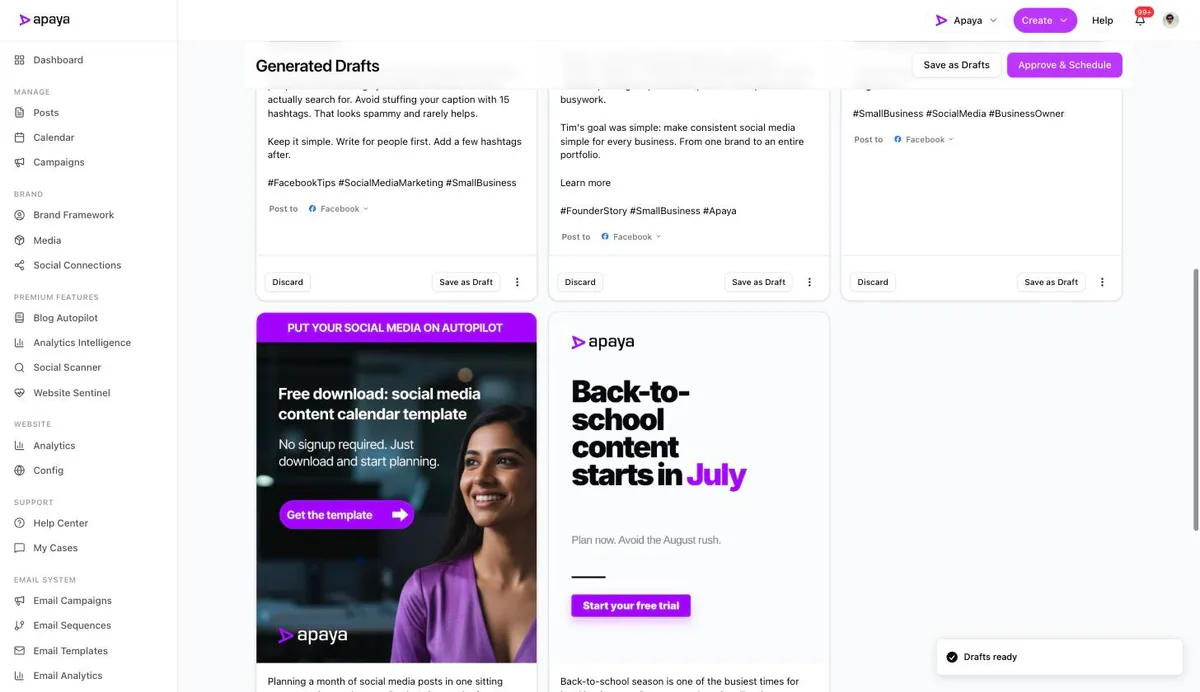
The plain offer (28) and the seasonal reminder (21) as finished drafts, with the review controls every generated post gets: keep, edit, or discard.
The 30-day Facebook calendar, filled in
A list solves the blank page; a calendar solves the blank month. This one runs on a weekly rhythm: proof Monday, education Tuesday, faces Wednesday, community Thursday, offer Friday, and light weekends. Days reference the ideas above, so every slot is a fifteen-minute job.
| Day | Post | Day | Post |
|---|---|---|---|
| 1 | Meet the owner (10) | 16 | Seasonal reminder (21) |
| 2 | The question of the week (18) | 17 | Team spotlight (11) |
| 3 | Workspace tour (12) | 18 | Local group presence day (39): answer, don’t post |
| 4 | Local moment (35) | 19 | Straightforward promotion (28) |
| 5 | Plain promotion (28) | 20 | Caption this (44) |
| 6 | Rest, or reshare a customer tag (38) | 21 | Rest |
| 7 | Genuine question (41) | 22 | Before and after (2) |
| 8 | Finished job (1) | 23 | Option A vs B (27) |
| 9 | The price explainer (22) | 24 | Day in the life (13) |
| 10 | Team member (11) | 25 | Neighboring business shout-out (36) |
| 11 | Cause post (37) | 26 | Real availability (29) |
| 12 | Seasonal package (30) | 27 | Rest, or local poll (43) |
| 13 | Rest | 28 | Review screenshot (3) |
| 14 | Before and after (2) | 29 | The myth (19) |
| 15 | Review screenshot (3) | 30 | Why you started (16), then repeat the rhythm |
Two ways to run it: copy this into the free calendar template and write the month in one batching sitting, or hand the rhythm to automation and approve the drafts. Either way, day 31 is just day 1 with fresh material, because the jobs repeat even though the posts never have to.
What to expect from Facebook
Organic Facebook engagement is thin: the benchmark data puts most industries well under 1%, and a growing share of feed views comes from Meta’s recommendations rather than your followers. That’s not a reason to skip the platform; it’s a reason to hold it to its real job. Facebook is where your existing community and checking customers confirm you’re alive, credible, and worth calling, and the 45 ideas above are built for that scoreboard, not for chasing a viral reach that the platform stopped handing out years ago. Post two to four times a week, answer your comments, and grade yourself on calls and messages, not likes. The Instagram version of this list is here, the LinkedIn version, ranked by format data, is here.
What else businesses ask
Should I post to my page or a Facebook group?
Both, differently. The page is your storefront: proof, faces, offers, the checkable record. Groups are where conversations and recommendations happen, and they reward participation, not promotion. Answer questions generously in local groups as yourself, and let the page be what people find when they click your name.
Do Facebook Reels matter for a small business?
They get disproportionate reach because Meta is pushing short video, and the same phone-shot process clips from ideas 6 and 13 work there. Worth doing when video comes naturally; not worth a production burden. The Facebook automation guide covers what AI can and can’t do for Reels.
What time should I post on Facebook?
Weekday mid-mornings are the published consensus, and timing moves results far less than consistency does. Pick times you can sustain; the scheduling methods guide covers the free ways to set and forget them.
My posts get no reach. Is my page broken?
Almost certainly not; that’s the platform now. Sub-1% engagement is the documented norm, and reach concentrates on posts that start conversations. Check your last ten posts against the five jobs: a feed that’s all offers gets treated like the advertising it is.
Thirty days, five jobs, fifteen minutes a day
Nobody’s Facebook feed needs to be clever. It needs to be alive, human, and useful when a potential customer checks it, which they will, this week. If the page itself is the missing piece, the business page setup guide gets you from nothing to live, a page QR code puts it in front of walk-in customers, and the rename walkthrough handles a rebrand without losing the page. Take the 45 ideas, run the 30-day rhythm, and let the page do its real job: being the proof that calling you is safe. Industry-specific versions of this list are rolling out, starting with dental practices, veterinary clinics, auto repair shops, real estate agents, lawn care companies, HVAC companies, and roofers, plus a year-round seasonal calendar.
Sources
- Rival IQ (Quid) and Socialinsider 2026 benchmark reports; Meta Widely Viewed Content Report, as documented in our Facebook benchmarks deep dive
- Meta’s published guidance on engagement bait demotion
- SERP format review of ranking idea lists, July 2026 (cited unlinked)
The easiest way to keep your social media profiles active.
Apaya writes the posts, designs the graphics, and publishes them for you. You approve.
See how Apaya worksThe easiest way to keep your social media profiles active.
Apaya writes your posts, designs your graphics, and publishes everywhere — automatically.