Automate X Posts: Auto Post to Twitter the Allowed Way
Written by: Tim Eisenhauer
Last updated:

The easiest way to keep your social media profiles active.
Learn more about Apaya →
Can you automate X posts?
Yes, and on this platform the case is mostly arithmetic. The median brand’s organic engagement on X rounds to 0.03%: three engagements per ten thousand impressions. At that rate, spending twenty minutes hand-crafting a post is a losing trade, and the businesses that stay on X sensibly are the ones that got the cost of posting near zero and moved their human minutes to replies. This guide covers the three ways to automate the posting, with the full flow shown in screenshots, and the line between allowed automation and the bot behavior X bans.
The short version
Apaya writes the X baseline in your voice, designs the graphics, and publishes on schedule with your approval, from $55/mo. Your minutes go to the replies, where X still pays.
The math first
The X benchmarks deep dive has the full picture: engagement collapsed to a rounding error, the platform rewards recency and reply depth, and the accounts that still win are people, not logos, because conversation is the product. The strategic conclusion isn’t “leave X.” For tech, media, finance, and founder-led businesses, it’s still where the discourse happens. The conclusion is that the scheduled content layer of X should cost you almost nothing, because at 0.03% it earns almost nothing per post; it exists as presence, search surface, and raw material for conversations. That’s a layer built to be automated.
Level 1: X’s native scheduler
On the desktop composer, the calendar icon schedules a post for a future date and time, and your pending posts live under the scheduled tab of the compose window. X Pro (the old TweetDeck, now behind the Premium subscription) adds the column-and-queue view power users remember. The free tier’s limits define it: one post at a time, no calendar overview, no cross-platform anything, and nothing about the writing. Fine for the occasional planned announcement, unworkable as a system.
A baseline week, concretely
What a scheduled X baseline looks like for a real business, so “baseline” isn’t hand-waving:
- Monday: one tip from your actual work, the kind your customers ask about.
- Tuesday: a number: a result, a price range, a before-and-after stat, stated plainly.
- Wednesday: a genuine question to your corner of the platform.
- Thursday: one of your guides or pages, posted natively: the insight in the post, the link in a reply.
- Friday: the take: one opinion you’d defend in person.
Five posts, all schedulable a week ahead in one sitting, all drawn from material you already have. The 45-idea list and its 30-day rhythm map to X briefs almost unchanged; shorten everything and drop the hashtag blocks.
Level 2: Auto-post and scheduling tools
The queue category, compared in full here, publishes through the official API on a calendar, often with an RSS-to-post option that auto-shares your new blog posts the moment they publish. If you go the RSS route, two settings decide whether it looks automated: rewrite the shared title into a human sentence where the tool allows it, and add UTM tags so your analytics can tell you whether X sends anyone at all. Useful plumbing, same boundary as everywhere: the queue holds what you wrote, and X’s appetite (daily posting, ideally more) makes that queue the hungriest in social media.
Level 3: Full automation, brief to scheduled baseline
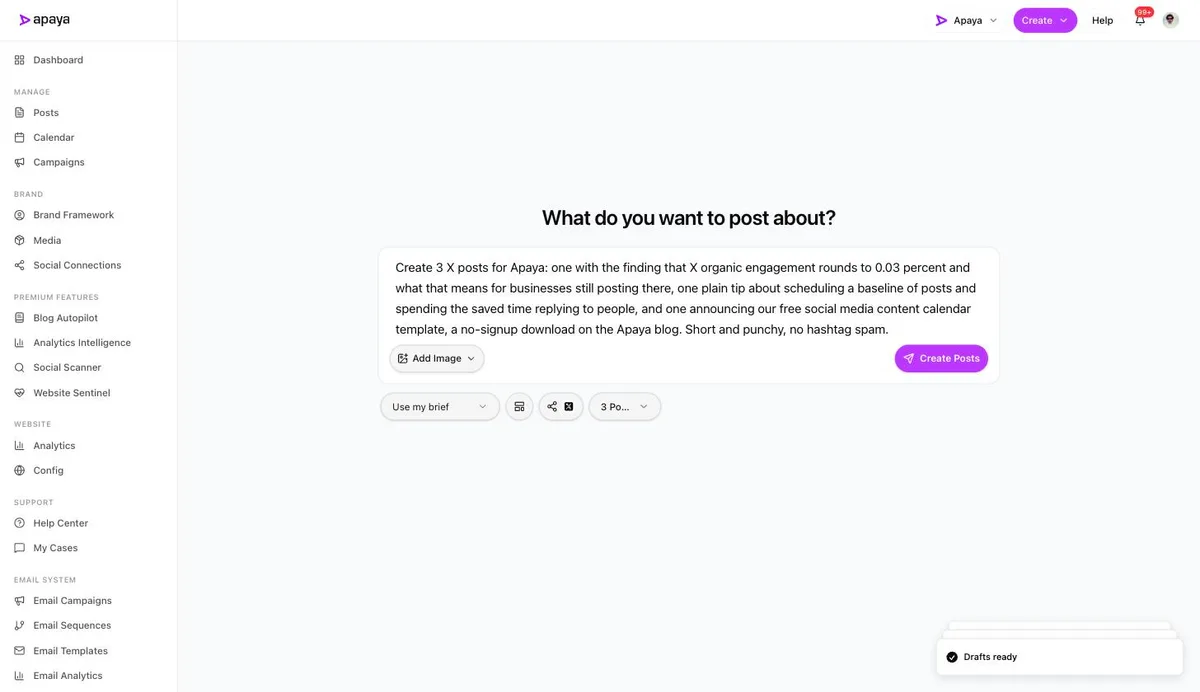
Here’s the flow in Apaya, captured live. We briefed three posts: the 0.03% finding itself, a schedule-then-reply tip, and a template announcement. X selected in the platform picker, three posts, create:
A minute later, the drafts: short, punchy, each with a designed graphic and a “Post to X” tag, each with keep-edit-discard controls, and Approve & Schedule for the batch:
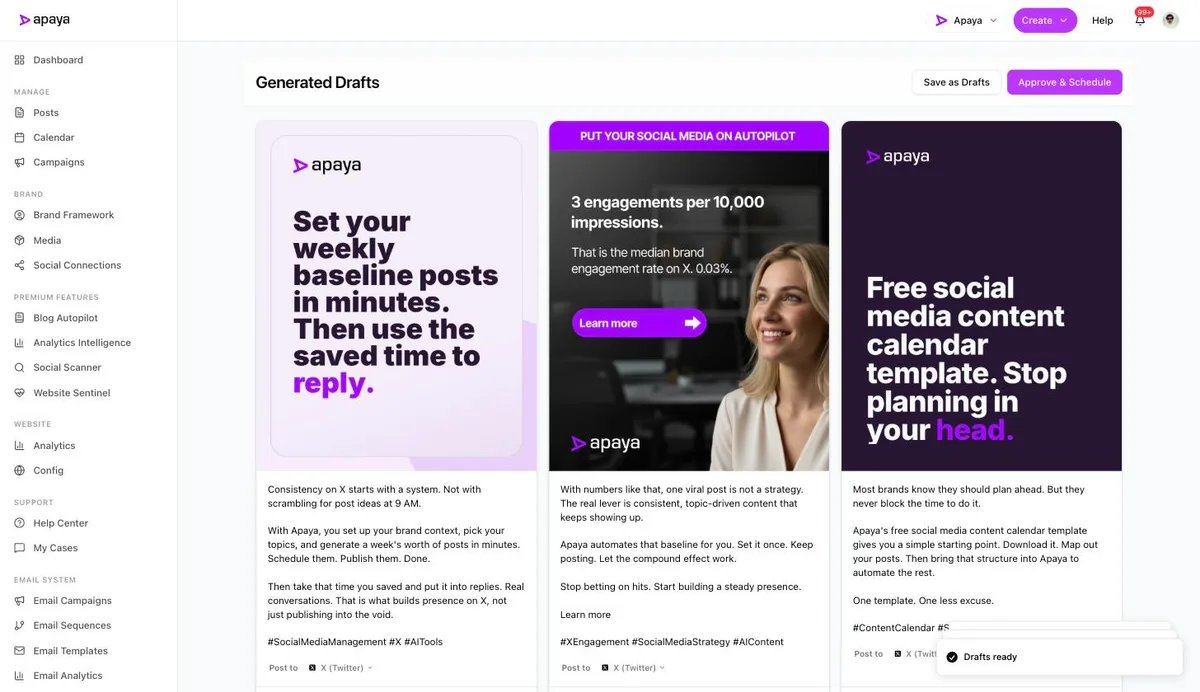
The middle draft’s graphic states the whole platform strategy: “3 engagements per 10,000 impressions. That is the median brand engagement rate on X. 0.03%.” The system wrote its own argument, we approved it, and the baseline for the week took two minutes. If the material already exists on your site, a pasted URL does the briefing too.
The line you should not cross
X names this in its platform manipulation and spam policy and its automation rules: no posting identical content across accounts, no mass-following and unfollowing, no auto-replies to strangers, no engagement-farming schemes, and API access required for programmatic posting. Half the “Twitter automation” tools in this SERP’s Reddit threads live outside those lines, and accounts pay for it with restrictions and shadow limits. The clean rule holds across every platform: automate what your account publishes, never how you touch other people’s, and keep a human approving what goes out.
Baseline by machine, presence by person
The accounts that work on X in 2026 pair a scheduled baseline with live humanity: the founder replying, quote-posting, and joining the day’s conversation. Automation cannot do the second part credibly and shouldn’t try; what it does is make the first part free. Schedule the baseline at the consensus morning windows, use AI tweet drafting if the writing itself is where you want help, and spend the recovered time in the replies. That mix is also why the make-money-on-X crowd keeps rediscovering the same rule: the algorithm pays for showing up, and showing up is two different jobs now.
What else people ask
Can it auto-post my blog posts to X?
Yes, two depths. RSS-to-post tools share the link with the title, which is the minimum viable version. The fuller version turns the page into native posts: paste the URL and the post gets written from the content rather than linked at it, which fits a platform that throttles naked links.
Does X downrank scheduled or API-published posts?
No. Publish method isn’t a ranking factor; recency, engagement velocity, and reply depth are. A scheduled post that starts conversations outranks a live post that doesn’t. What reads as automated and gets ignored is generic content, which is a voice problem, not a scheduling problem.
Can automation write threads?
Threads are the one format on X that still earns outsized reach, and they’re also the format that most needs a human’s judgment about structure and payoff. The workable split: automation produces the single-post baseline, and threads get written deliberately, with AI drafting help if you want it, at the pace you have real material for. A forced weekly thread reads like one.
Is X worth automating for a local business?
Usually it’s the platform to skip entirely; the platform-fit guidance points local businesses at Facebook, Instagram, and Google first. If X costs you nothing because the baseline runs itself, keeping a presence is defensible; if it costs you hours, those hours belong elsewhere.
What does it cost?
The full-automation rung runs $55 to $183 a month at current pricing; the cost ladder has every cheaper and pricier rung. Measured against what X returns organically, the only rational spends on this platform are near-zero money or near-zero time.
Make X cost nothing, then decide if you like it
At 0.03%, X is not a place to spend effort; it’s a place to be present while spending none. Automate the baseline, approve it weekly, show up live when the conversation is worth it, and let the platform prove whether it deserves more than that.
Sources
- Rival IQ (Quid) 2026 benchmark data (X median engagement), as documented in our X deep dive, cited unlinked
- X API and automation rules, verified July 2026
- Apaya product screenshots captured live from my.apaya.com, July 2026
The easiest way to keep your social media profiles active.
Apaya writes the posts, designs the graphics, and publishes them for you. You approve.
See how Apaya worksThe easiest way to keep your social media profiles active.
Apaya writes your posts, designs your graphics, and publishes everywhere — automatically.