Keep social media on brand across locations with a Brand Framework.
Apaya keeps social media on brand across locations by giving every brand and location its own Brand Framework, a structured set of brand instructions that guides every AI generation pass. Apaya can generate the framework from a website, selected pages, pasted guidance, existing content, or brand assets, including voice, audience, USPs, calls to action, banned phrases, approved language, and visual identity. Your team edits it. Every caption, image, hashtag, and campaign asset is generated against the framework, so brand consistency across locations does not depend on who is at the keyboard. The framework lives in your Apaya account and stays with you.
The common reason enterprise teams hesitate on AI content tools is brand fit. The buyer believes AI is fast. The buyer worries that AI is brand-blind. Without something between the prompt and the post, AI produces text that sounds like the internet. Brand teams spend the first months of any AI rollout fixing voice, removing banned phrases, and re-teaching the tool what good looks like.
The same worry shows up in a second form at multi-location companies, and it predates AI: 40 locations posting in 40 voices, with corporate finding out after the fact. Keeping social media on brand across locations has always been a supervision problem, and supervision does not scale by adding reviewers.
Apaya Enterprise answers both with the Brand Framework, a structured instruction set that defines the brand before any post is generated. Every location has one. The framework is the contract between the brand team and the AI.
What keeps social media on brand: the Brand Framework.
The Brand Framework is a set of structured fields per brand that captures who the business serves, what it sells, how it talks, what makes it different, and how the brand should look and sound.
It is editable by the brand team. Captions, images, hashtags, carousels, and campaign assets all consume the framework as context on every social media content production pass. It lives in your Apaya account.
The framework is the difference between an AI tool that types fast and an AI tool that produces on-brand work.
Brand consistency across locations breaks when every post starts from a prompt.
The fastest way to break an enterprise rollout of AI content is to lean on prompts. Prompts work in single-user tools. They do not scale across locations, reviewers, and weeks.
A prompt approach forces every generation pass to renegotiate the brand. The marketer types the brand context into the chat. Forgets a phrase. Misses a USP. The output drifts. The next marketer types a different version of the brand context. Different people, different prompts, different drift. Voice consistency depends on whoever sits at the keyboard, which is the same failure a guidelines PDF has at 40 locations.
A structured instruction set fixes the brand context in one place. Apaya creates the framework from the website, selected pages, pasted guidance, existing content, or brand assets, and the brand team edits it. The AI consumes the framework on every pass, for every reviewer, campaign, location, and channel. Brand consistency across locations holds because the instruction set is the source, not the person writing the post.
How the framework gets built
A new brand joins Apaya. The team provides the website URL, selected pages, pasted guidance, existing content, or brand assets. Apaya uses that material to draft the Brand Framework with voice, audience, USPs, calls to action, writing samples, and brand identity.
The brand team reviews the draft. Sharpens the voice description. Adds banned phrases. Edits the audience description. Locks the USPs. Approves or replaces writing samples. Uploads brand assets. Reviews colors and templates. Locks the hashtag pool.
The framework is live. Every campaign references it.
Inside the framework: voice, visual identity, and brand compliance rules.
The framework spans business identity, voice, audience, content rules, and visual identity. The fields:
- Brand profile. Name, website, email, phone, timezone, default brand status. Sets the scope for the framework.
- Brand Blueprint. About, vision, industry, niche, target audience, pain points, USPs, tone, and calls to action. The narrative spine of the brand.
- Brand identity. Logos, dark logos, icon variants, brand colors, color palettes. Used in image generation, templates, and visual assets.
- Templates. Reusable design templates per brand. Carousel templates, story templates, post templates. Honored on every image generation pass.
- Topics and categories. Content pillars per brand. Apaya draws from the pillars when generating campaign topics.
- Content settings. Caption length, emoji usage, self-promotion rules, post language, writing samples, hashtag mode (AI, custom, hybrid, none), banned phrases, approved language. The voice rules that shape every caption.
- Asset library. Uploaded creative assets per brand, including photography, brand graphics, and video.
Banned phrases and approved language are the brand compliance layer. Corporate sets the words a location cannot use and the approved way to describe a product, a claim, or an offer, and every generation pass honors both. Regulated networks use the same two fields to keep required and prohibited language consistent across every location before a reviewer ever sees the draft.
The framework is editable by the brand team, with role-based access controls on who can change which fields.
How the Brand Framework guides social media content generation
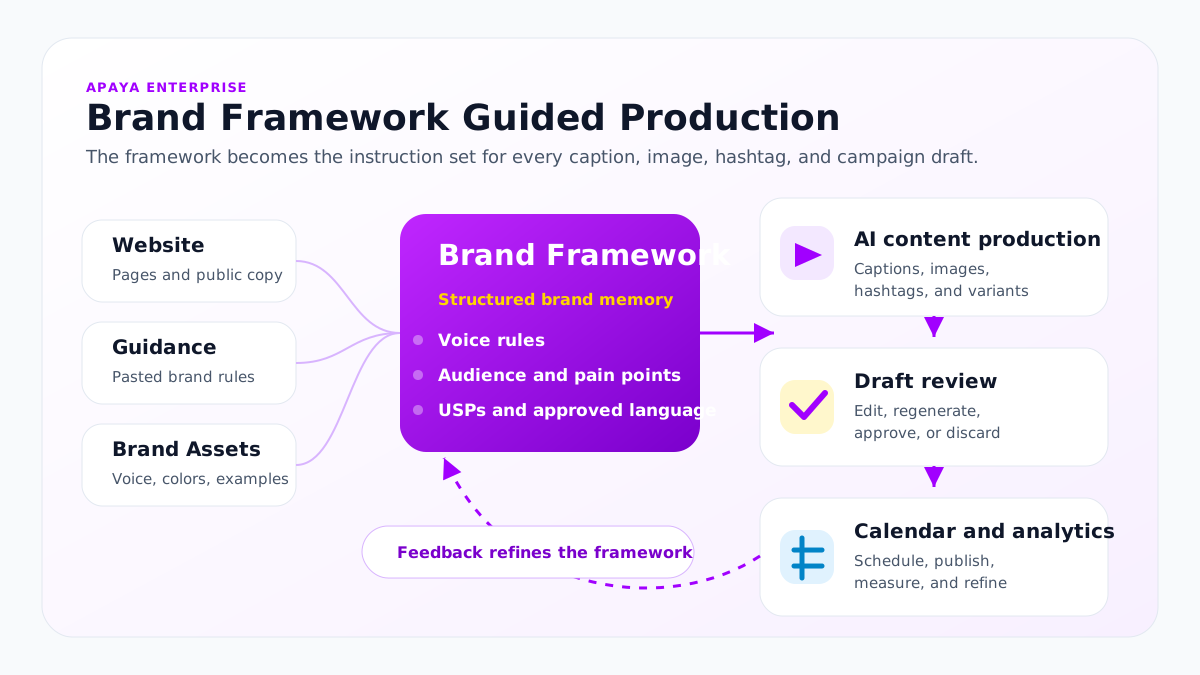
Every AI generation pass reads the Brand Framework as context. The flow:
- The marketer launches a campaign or quick post.
- Apaya pulls the active brand’s framework, including voice, audience, USPs, content settings, hashtag pool, brand identity, templates, and writing samples.
- The frontier model (OpenAI, Anthropic, or Google Gemini) generates content with the framework as context.
- The output reflects the framework in voice, language, and visual identity.
- Drafts land in the social media approval workflow, where the team checks brand fit before approval.
- Reviewers edit, regenerate with feedback, approve, or discard.
When a reviewer regenerates with feedback, the feedback joins the framework as context for that generation pass. The framework itself does not change unless the brand team edits it.
How the framework relates to the AI models
The Brand Framework is a structured instruction set. The platform does not train a custom model per customer. Frontier models such as OpenAI, Anthropic, and Google Gemini do the generation. The Brand Framework is the structured context those models consume.
This distinction matters for procurement. Apaya does not train a custom model per customer; it uses the Brand Framework as structured context for generation. The framework lives inside your Apaya account; it is yours to edit, export, and own.
The full security and procurement story sits on the roles and permissions page.
Keep social media on brand across locations, regions, and brands.
Each brand and location inside an Apaya tenant has its own framework. A holding company with 12 brands has 12 frameworks. A franchise network with 80 locations has the option of one framework per location, one per region, or shared frameworks with location-specific overrides.
That structure is what makes brand consistency across locations workable in both directions. Shared fields hold the parts corporate owns: voice, USPs, banned phrases, approved language, logos, colors, and templates. Location overrides hold the parts that should stay local: the market, the team, the offers, the events. A location reads as local without reading as a different company.
Frameworks are editable by the brand team for that brand or location. Corporate marketing has visibility across frameworks for governance.
This is how Apaya keeps voice locked across multi-brand social media management. Each framework is the source of truth for that brand or location, and the AI does not blend voices across them.
Governance, ownership, and exit
The framework is a strategic asset. Apaya treats it that way.
- Editable by your team. Voice, audience, USPs, calls to action, and content rules all sit in the framework as editable fields. The brand team owns updates.
- Updated as the brand changes. The brand team can add, edit, or update the framework whenever messaging, offers, audiences, or voice rules change.
- Exportable. The framework, templates, and content history are exportable on request. The asset stays with you.
- Yours if you leave. If you stop running on Apaya Enterprise, the Brand Framework, templates, and content history stay in your Apaya account. You can keep the account on a self-serve plan, or stop. Your work is yours.
Why a framework like this beats a guidelines PDF, and how to audit how far your accounts have already drifted, is covered in social media brand consistency across locations and brands.
What’s in production
60 customer brands run on Apaya, each with its own Brand Framework. The framework is the operating layer that lets Apaya generate captions, images, hashtags, and campaign assets from the same structured brand source.
How the Brand Framework gets started
Apaya can create the first usable version of a Brand Framework quickly when the team brings the right inputs. Enterprise timing depends on review cycles, approvals, and how much the brand team wants to refine before generating content.
- Create or import the framework. Apaya can generate the framework from a website, selected web pages, brand documents, messaging guides, product pages, writing samples, or a combination of sources.
- Review the fields. The brand team edits voice, audience, USPs, calls to action, banned phrases, approved language, content settings, templates, and brand identity.
- Generate drafts to validate it. Apaya uses the framework to create social drafts. Reviewers edit, approve, or regenerate with feedback, which shows where the framework needs sharpening.
- Keep the framework current. As messaging, offers, audiences, products, or voice rules change, the team updates the framework so future campaigns use the current brand source.
The goal is not a long implementation cycle. The goal is to get the brand source of truth into Apaya, test it against real social content, and keep improving it as the brand evolves.
Frequently asked questions
How does Apaya build a Brand Framework from a website?
+
Can we edit the framework after it is generated?
+
Does each brand have its own framework?
+
Is the framework training a custom model?
+
What happens to our framework if we leave Apaya?
+
Can we add banned phrases and approved language?
+
Does the framework cover visual identity?
+
Related
-
AI content production
Social media content production software for content production at scale: campaigns, captions, branded graphics, hashtags, approvals, scheduling, publishing, and reporting.
-
Approval workflows
Social media approval software for AI-generated posts: a content approval tool with team roles, a brand-scoped asset library, regenerate-with-feedback review, and draft, scheduled, published, failed states. Nothing publishes unchecked.
-
Implementation plan
A practical Apaya Enterprise implementation plan for launching social content production across brands, assets, templates, approvals, publishing, reporting, API access, and support.
-
Franchise networks
Franchise social media management software that creates on-brand posts for every location, routes franchisee approvals, and publishes from one workspace.
-
Insurance networks
Insurance social media management software for agencies and networks. Create approved posts across agents, offices, carriers, and campaigns.
-
Financial services
Financial services social media management software for branches, advisors, and regions. Create approved posts with review workflows and reporting.
Schedule an Apaya Enterprise demo.
See how Apaya helps your team produce more on-brand social content across every brand without adding headcount.