White Label Social Media Management: What It Includes, Pricing, and Reseller Margins
Written by: Tim Eisenhauer
Last updated:

The easiest way to keep your social media profiles active.
Learn more about Apaya →
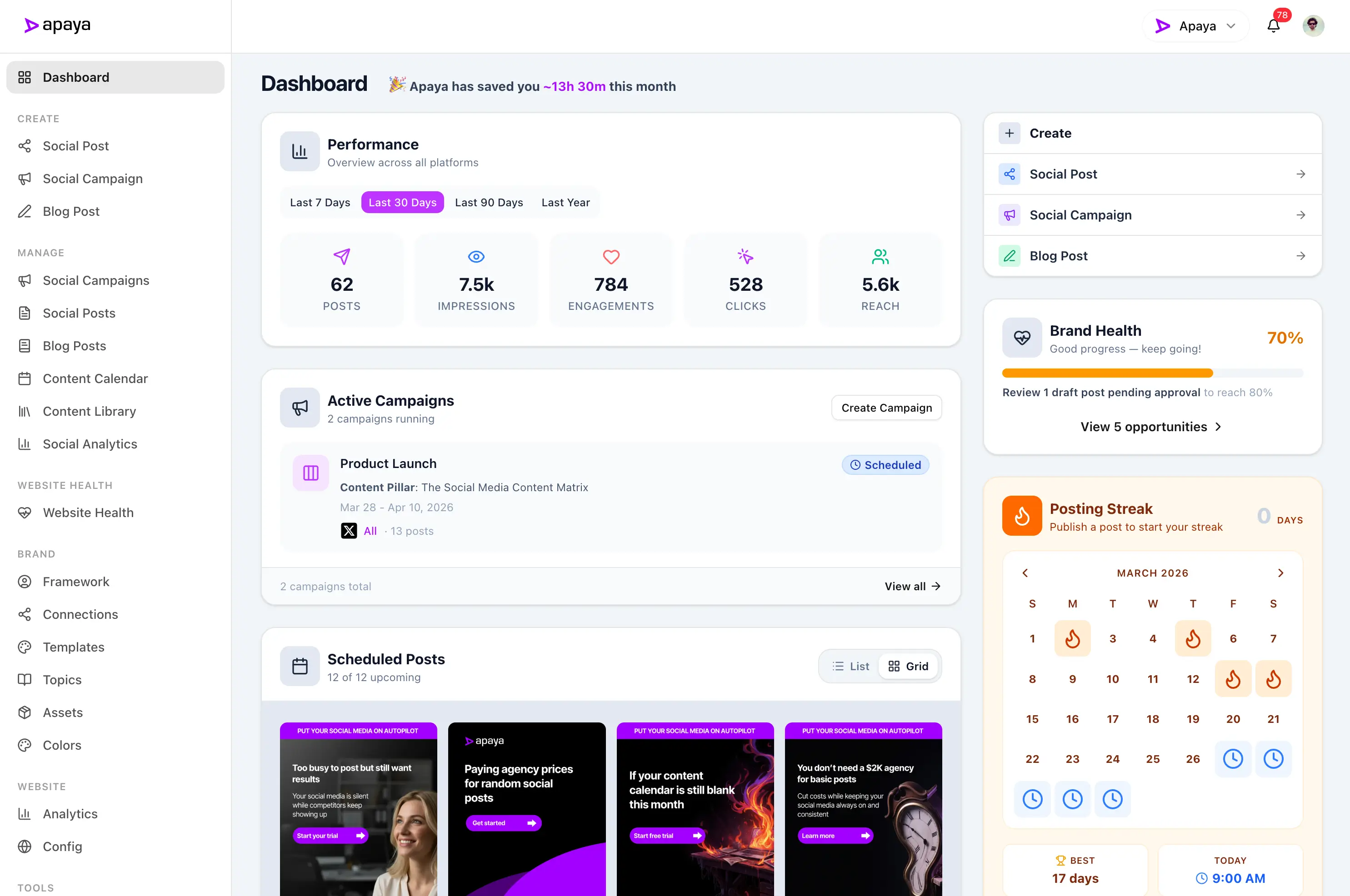
Apaya's Social Media Management Software.
Apaya creates, schedules, publishes, and reports on every client's social media under your agency's brand.
Learn MoreWhite label social media management is when an agency uses a third-party platform to handle production work, while the client-facing experience carries the agency’s brand: the platform, the sign-in page, the invitations, the results. The client experiences a polished, branded operation. How you produce it is your business. You’ll see it written as white-label, whitelabel, or white label social media marketing. Same model in every case.
AI-powered white-label social media platforms add content production to the equation, letting agencies brand the entire pipeline rather than just the dashboard.
This guide covers the three white-label models, exactly what’s included in Apaya’s white label social media management software (which went live in July 2026), what everything costs, and the margin math that makes agencies resell it.
Here’s the observation that makes agencies take this seriously: every client touchpoint either builds your agency’s brand equity or transfers it to your vendor. There’s no neutral option. Every screen your clients see reinforces your agency’s brand, or someone else’s.
White-label isn’t about hiding the tools you use. Every agency uses tools, the same way law firms use research databases and creative shops use Adobe. White-label is about making sure the work clients see, experience, and remember is unmistakably yours. (If you’re new to the broader agency automation conversation, start with our pillar piece on AI social media production for agencies.)
Key takeaways.
- Three white-label models exist: scheduling software (you still create everything), done-for-you services (generic quality), and AI platforms (content production plus branding in one).
- White-label is brand equity, not vendor concealment. Every branded touchpoint reinforces your agency’s identity instead of someone else’s. That compounds over the life of the engagement.
- AI changes the economics. Traditional white-label tools brand the dashboard. AI white-label platforms handle production and the branded experience, freeing your senior team to spend their hours on strategy instead of caption writing.
- Audit every client touchpoint, and every vendor claim. Plenty of “white-label” tools leave branding gaps, and plenty of white-label marketing pages describe features that aren’t live. Ask for the exact list of what’s rebrandable today.
- Per-brand pricing beats per-user pricing. Your tool cost scales with client count, not with how many strategists, creative directors, and account leads you have on the platform.
What is white label social media management?
White label means the client-facing experience carries your agency’s brand. Your name on the platform. Your logo on the sign-in page. Your identity on the invitations. The vendor recedes. Your agency is the brand the client experiences.
This matters for three reasons:
-
Brand equity. Every screen, invitation, and report view is an opportunity to reinforce your agency’s identity. When those touchpoints carry your brand, you’re building equity with every deliverable. When they carry a vendor’s brand, you’re building someone else’s instead.
-
Strategic positioning. Every agency uses tools: Adobe, scheduling platforms, analytics dashboards, research databases. Your internal operations don’t belong in your client’s field of view, the same way a law firm doesn’t show their research subscription line items. White-label keeps the operational decisions where they belong: with you.
-
Professional presentation. A branded workspace with your agency’s name and colors reflects the strategic work behind it. A generic dashboard with a vendor’s logo signals that the work was assembled, not crafted. Same data, different message about who’s doing the thinking.
Most agencies figure this out the hard way. They send something with vendor branding, and the next client conversation starts a half-step lower than it should.
The three models of white-label social media management.
Not all white-label solutions are the same. There are three distinct models, and they serve completely different agency types.
Model 1: White-label scheduling software.
Platforms like Sendible, SocialPilot, and Agency Analytics let you put your logo on the dashboard and reports. The client logs into a portal with your branding. Reports go out with your colors.
What you still do manually:
- Create all the content (captions, images, hashtags)
- Design graphics in Canva or Photoshop
- Write copy for every post
- Build content calendars from scratch
The gap: These tools white-label the scheduling and reporting, not the content creation. Your team still spends 15-20 hours per client creating the posts that go into the scheduler. The white-label branding is a thin skin over a labor-intensive process.
Model 2: White-label done-for-you services.
Companies like $99 Social, Content Fly, or MixBloom offer wholesale content creation. You buy posts at wholesale rates and resell them under your agency brand.
What you get:
- Pre-written posts (usually generic)
- Basic images
- A content calendar you can present as your own
The gap: Quality control. These services are writing for hundreds of agencies simultaneously. The content reads like it was written by someone who spent 90 seconds on the client’s website. Because it was. Your clients will notice when their “custom” posts sound identical to every other small business in their industry.
Model 3: White-label AI platforms.
This is the newer category, and the one that changes the economics. Platforms like Apaya use AI to crawl each client’s website, learn their brand voice, and generate posts specific to that business. Then they let you white-label the platform itself.
What the AI handles:
- Content creation (captions, hashtags, image generation)
- Brand voice matching per client
- Scheduling and publishing
- Analytics that feed the next round of content
What gets white-labeled:
- The platform your team and clients use, from sign-in onward
- Your name, logos, favicon, and colors on the interface
- Workspace invitations
- Your support contact details
The difference: The AI creates the content AND the platform wears your brand. You’re not just white-labeling a dashboard. You’re white-labeling a production pipeline.
What white label includes at Apaya.
Apaya’s white label went live in July 2026, and because vague white-label promises are an industry disease, here is the exact list of what you can rebrand today:
| Surface | What you control |
|---|---|
| Platform name | Your name across the interface and the browser tab |
| Logos | Separate light-mode and dark-mode logos |
| Favicon | Your icon in the browser tab |
| Colors | Primary color (preset or exact hex) across buttons, tabs, links, schedules, and editors, with button text set automatically for readability |
| Support contact | Your support name, email, and URL |
| Setup controls | Live light and dark previews, draft saving, one-switch activation, disable and restore anytime |
| Sign-in page | Carries your branding, not ours |
| Workspace invitations | Team and client invites arrive branded as your platform |
| Client content | Seven brand colors plus heading and body fonts per client, enforced across generated posts, carousels, and templates |
Custom domain mapping is in development. When it ships, the platform will live on your own hostname. Until then, the list above is what’s live, and we would rather you know exactly where the line is than discover it mid-rollout.
White label is included in the Supernova plan at flat per-brand pricing (current rates on the pricing page), and everything on this list is testable in the trial.
White label social media services vs software: build or resell?
The services-vs-software question boils down to where your production capacity comes from. Here’s the decision framework:
-
Choose white-label software if you have a content team and the bottleneck is presentation, not production. You write the posts; the software gives you branded scheduling, dashboards, and reports. Your cost is the subscription plus your team’s hours.
-
Choose white-label done-for-you services only if you’re reselling on volume and your clients accept template-grade content. The margin per client looks good on paper, but churn from generic content usually eats it. This model works for sub-$500/month retainers and almost nowhere else.
-
Choose a white-label AI platform if you want software economics with the production problem handled. The AI generates content matched to each client’s voice, your team reviews and approves, and the platform carries your brand. You keep editorial control without staffing a production line.
White label social media marketing services, without the service markup.
Agencies searching for “white label social media marketing services” are usually pricing done-for-you fulfillment: someone else’s writers producing content they can resell. The AI-platform version of that trade keeps the deliverable (client-ready content under your brand) and removes the wholesale labor layer, which is where both the quality problems and the margin squeeze live. You get service-grade output at software pricing, and your team stays the editorial gate.
For the full services-side breakdown, including what subcontracted fulfillment costs and the questions to ask a partner, see white label social media services: what they include.
Whichever model you pick, the handoff between production and client sign-off is where white-label arrangements usually break down. A branded platform doesn’t help if posts sit in limbo waiting for approvals. Our guide to social media approval workflows for agencies covers how to keep that loop tight without adding meetings.
White label social media reseller programs
The reseller framing is the same model from the vendor’s side: you buy platform capacity at per-brand rates, mark it up inside your retainers, and own the client relationship. What separates a real reseller program from a logo swap: per-brand wholesale pricing that leaves margin at your retail price, your agency owning the client relationship, and branding that holds up everywhere the client looks. Ask the uncomfortable question first: what happens to your clients if you stop reselling? If the vendor keeps them, it was never your program.
We built a dedicated social media reseller program page covering how the Supernova model works as a program: the per-brand economics, what’s included, and how agencies onboard their first client batch. For the model itself, wholesale-to-retail mechanics and the margin math per client, see how social media reseller programs work.
White label social media platforms: what the word buys you
“Platform” in this market means the software itself wears your brand: your logo on the dashboard, your name in the browser tab, your favicon next to it. The distinction that matters is platform versus service: a white-label platform is software your team and clients use under your brand; a white-label service is someone else’s team doing the work invisibly. Platforms scale with software margins and your labor; services scale with someone else’s labor and thinner margins. Most agencies asking this question want the platform with the AI doing the production, which is the Model 3 shape described above.
What does white label social media management cost? With Apaya, a flat per-brand rate on the Supernova plan (current rates) against retail retainers of $500 to $2,000, which is the margin that makes the model work. The pricing section below has the full breakdown.
White label social media management software: what to look for.
After watching agencies struggle with this for years, here are the features that separate real white-label from “we put your logo in the corner.”
The branding holds up everywhere clients look.
Your name, your logos, your colors, from the sign-in page to the browser tab to the invitation email a client receives. Most “white-label” tools do this partially: logo swapped on the dashboard, vendor name still in the tab title or the invite. Audit every touchpoint before you commit, and ask the vendor for their exact list of branded surfaces. (Ours is the table above.)
Content production underneath the branding.
The branding is the wrapper. The question that decides your margins is what’s inside it: if the platform doesn’t produce the content, your team is still the production line, and the white label is cosmetic. This is the line between Model 1 and Model 3, and it’s worth more than every other feature on the comparison sheet combined.
Per-brand pricing.
With per-user pricing, adding a strategist or account lead raises your software bill regardless of client count. With per-brand pricing, your cost is tied directly to revenue. Every new client has a predictable, fixed tool cost, which makes margin math straightforward when you quote retainers.
A vendor that tells you what’s live.
White-label marketing pages are notorious for describing roadmaps in the present tense. Ask which features are live today and test each one in the trial. A vendor who answers that question precisely will also answer support tickets precisely.
White label social media dashboard and client experience.
The dashboard is the surface clients see most, so it’s where white-label either holds up or falls apart. When someone logs in to review content or check results, they should see your agency’s brand, not a generic SaaS interface with your logo pasted in the header.
In Apaya, the white-labeled experience covers:
- The sign-in page, carrying your name, logo, and colors before anyone reaches the dashboard.
- The interface itself: your platform name in the browser tab, your favicon, your primary and button colors across the UI.
- Invitations: when you add a teammate or client, the email and join flow carry your platform’s branding.
- Support: help links point to your support name, email, and URL, so questions come to you.
- No vendor signup links in your workspace inviting your clients to go direct.
One note, stated plainly because we hold vendors to this standard and should hold ourselves to it: the platform currently runs on Apaya’s domain, with your branding on it. Custom domain mapping (your own hostname) is in development.
White label social media management software compared.
Before getting into pricing, here’s how the main white-label platforms agencies evaluate compare side by side:
| Platform | What’s branded | Content production | Pricing model | Custom domain |
|---|---|---|---|---|
| SocialPilot | Dashboard, basic reports | Manual (your team writes) | Per user, $50-$150/mo | Limited |
| Sendible | Dashboard, reports, portals | Manual (your team writes) | Per user, $89-$240/mo | Yes |
| Agency Analytics | Reports only | N/A (reporting tool) | Per dashboard, $79+/mo | Yes |
| Hootsuite Enterprise | Dashboard, reports | Manual | Custom (per seat) | Yes |
| Apaya | Platform UI, sign-in, invitations, plus each client’s content | AI generates the content; your team reviews and approves | Per brand (see pricing) | In development |
The biggest distinction isn’t whether the platform supports white-label. It’s what’s underneath. Most white-label tools brand the dashboard while your team produces everything. The newer category brands the platform and produces the content.
White label social media posting: how AI fulfillment works.
Posting is the fulfillment layer: who creates the content, who approves it, and how it gets published. Here’s the day-to-day reality for an agency using a white-label AI platform:
Monday morning: You log into your dashboard. AI has generated the coming week’s content for every client brand. Each brand has platform-specific posts with captions in that client’s voice and graphics in that client’s fonts and colors.
Your job: Scan the content. Flag anything that needs adjustment. Maybe Client A’s tone is slightly off, so you tweak two captions. Client B has a product launch next week, so you add a custom post. Client C is perfect, so you approve the batch.
Quality control you didn’t have to build: every batch runs through the same pipeline that writes and checks every Apaya post, including deterministic QA that catches duplicate angles, repeated openers, and off-template copy before your team ever reviews it. The anti-repetition problem that makes resold content look resold is handled in the machine.
Approvals: posts route through approval workflows with per-brand settings, so nothing publishes without the sign-off structure you configure.
Time spent: minutes per client per day. One strategist can carry a roster that used to need a content team.
How white-label AI changes agency economics.
Here’s where the math gets interesting.
With a traditional white-label scheduling tool, you’re paying for the right to brand a dashboard. That’s it. Your senior team still spends 15-20 hours per client assembling content. The white-label is cosmetic, and your strategists are still buried in production work.
With a white-label AI platform, the AI generates the content and your team reviews, refines, and approves. The production layer runs underneath. Your senior people get the hours back, and the platform still carries your agency’s brand.
Traditional white-label model (20 clients):
- Tool cost: $200/month (SocialPilot Agency plan)
- Content team: 3 FTE × $5,000/month = $15,000 (most of their hours on production)
- Total: $15,200/month
- Revenue at $1,500/client: $30,000/month
- Direct margin: 49%, and your senior team has minimal strategic capacity
AI white-label model (20 clients):
- Tool cost: one flat per-brand rate per client (current rates), a fraction of one content salary at 20 clients
- Content team: 1 strategist reviewing and approving × $5,000/month
- Revenue at $1,500/client: $30,000/month
- Direct margin: far higher, with most of your strategist’s hours going to strategy and client work
Same revenue. Same client experience. The difference is roughly two full content salaries, and the more strategic number is that your senior team now has the bandwidth to deepen client relationships, pitch bigger accounts, and do the work that earns rate increases at renewal. (For a deeper look at how pricing and margin math work across different agency models, see our agency pricing guide.)
At 50 clients, the gap widens. The traditional model needs 7-8 content people producing under brand pressure. The AI model still needs one strategist doing review and one creative director doing oversight, and the rest of your senior capacity goes into the strategic work that compounds. That’s the play behind why production is the real bottleneck for agency scaling.
White label social media reports and analytics.
Reporting is where retainers get renewed, and it’s the second-most-searched white-label feature after the dashboard itself. In Apaya, cross-platform analytics, campaign performance cards, and post-level results live inside the white-labeled platform: clients review their numbers in a workspace that carries your name, your logos, and your colors. The agency reporting toolkit covers the analytics themselves: what’s tracked per platform, campaign comparisons, and the metrics that hold up in client meetings.
What to check with any vendor: where clients view results in practice (inside the branded platform, or in an emailed PDF with someone’s footer on it), and whether the reporting layer is included or an add-on priced per workspace.
White label social listening for agencies.
An underserved corner of the market: agencies want listening and lead discovery they can offer clients without adding another vendor logo to the stack. Apaya’s Social Scanner monitors platforms like Reddit and X for conversations relevant to each client, scores them, and surfaces recommended replies your team can act on. Because it lives inside the white-labeled platform, the listening workflow runs under your agency’s brand like everything else, and it’s included rather than priced as a separate module.
How much does white label social media management cost?
White-label platforms for agencies typically fall into three pricing tiers:
Budget tier ($30-100/month): SocialPilot, Vista Social. Basic white-label on reports and dashboards. Limited customization. Usually per-user pricing that gets expensive as your team grows.
Mid tier ($100-300/month): Sendible, Agency Analytics. Stronger white-label with branded portals and better report customization. Still per-user pricing in most cases.
AI tier (per-brand pricing): Apaya. Platform white-label PLUS AI content creation, at flat per-brand pricing on the Supernova plan (current rates). Per-brand instead of per-user, meaning your cost scales with clients, not team size. Contact us about volume pricing for larger rosters.
The per-brand vs. per-user distinction matters enormously for agencies. With per-user pricing, adding a team member increases your costs regardless of how many clients they manage. With per-brand pricing, your cost is directly tied to revenue. Every new client you onboard has a predictable, fixed tool cost. If you’re trying to benchmark these numbers against the broader market, our breakdown of AI social media management costs covers what businesses are paying across every pricing model.
When white-label matters and when it doesn’t.
White-label is essential when:
- You charge premium rates. If clients pay $2,000+/month, every deliverable should reflect the strategic work behind it. Generic tool branding sends the wrong signal about who’s doing the thinking.
- You serve enterprise or mid-market clients. Larger clients have procurement teams who pay attention to the brand experience. Consistent agency branding signals operational maturity.
- You position as a full-service agency. “We handle everything” falls apart when clients see three different tool logos across their touchpoints.
- You’re building long-term agency brand equity. Every client touchpoint that carries your brand is equity you keep. Every one that carries a vendor’s brand is equity you don’t.
White-label matters less when:
- You’re a freelancer or solo consultant. At 3-5 clients, your clients probably know you’re using tools, and they’re fine with it.
- You charge budget rates. At $500/month, clients aren’t expecting a bespoke branded experience. They want results.
- Your clients are tech-savvy and don’t care. Some clients, especially SaaS companies, would rather you use the best tool than spend energy hiding it.
Frequently asked questions.
What is white label social media management software?
Software that lets an agency run scheduling, approvals, and reporting under its own brand. Clients see the agency’s logo, colors, and name instead of the vendor’s. Traditional options like Sendible and SocialPilot brand the dashboard but leave content creation to your team. AI platforms like Apaya also generate the content underneath the branding.
What does Apaya’s white label include?
Your platform name, light and dark logos, favicon, primary color, button text color, and your own support contact details, applied across the interface, the sign-in page, and workspace invitations. Each client brand gets seven colors and dedicated heading and body fonts enforced across generated content. Custom domain mapping is in development.
What is a white label social media dashboard?
A dashboard that carries your agency’s branding instead of the vendor’s: your name in the browser tab, your favicon, your logos, and your colors. In Apaya this is configured under Account, then White Label.
Where can agencies get white-label social listening software for clients?
Look for platforms where listening lives inside a rebrandable interface instead of a separate tool with its own branding. Apaya’s Social Scanner monitors Reddit, X, and other platforms for client-relevant conversations and surfaces recommended replies, inside the white-labeled platform.
Which social media management platform provides white-label reports?
In Apaya, analytics and campaign results live inside the white-labeled platform, so clients review performance in a workspace carrying your brand. When comparing vendors, check where clients view results and whether reporting is included or a paid add-on.
Should agencies use white label social media services or software?
Use white-label software if you have a content team and only need branded scheduling and reporting. Use done-for-you services only if you can accept generic content quality. AI white-label platforms combine both: production plus branding, at per-brand pricing.
What’s the difference between white-label and reselling?
Reselling means you buy a service and mark it up: the client often knows the provider exists. White-label means the provider’s brand recedes and the client interacts with yours. The reseller program combines both: per-brand wholesale pricing under your branding.
Do clients care if agencies use AI to create their content?
Most don’t, as long as the quality is good and the content sounds like their brand. If you’re reviewing and refining AI output before it goes out, the quality conversation rarely comes up. What clients notice is inconsistency, missed deadlines, and generic content.
How much does white-label social media management cost for agencies?
Budget white-label scheduling tools run $30-100/month and mid-tier platforms $100-300/month, usually per user. Apaya uses flat per-brand pricing on the Supernova plan with AI content production included; current rates are on the pricing page.
Does white label cover social media advertising?
Apaya handles organic content production, scheduling, publishing, listening, and analytics under your brand. Ad buying and paid social stay with your team or your ads platform.
Who offers white-label social media solutions for multinational companies and brands?
Look for multi-brand architecture rather than per-seat licenses. In Apaya, each market, subsidiary, or brand runs as its own workspace brand with its own voice, visual identity, connected accounts, and approval settings, inside one white-labeled platform carrying your organization’s name. A multinational footprint scales by adding brands at the flat per-brand rate, and language and voice are configured per brand for companies operating across markets.
Making the switch.
If you’re running an agency on scheduling tools and manual content production, the transition to a white-label AI platform looks like this:
-
Start with 3-5 clients. Don’t migrate everyone at once. Pick clients where you can measure the impact, ideally ones where production is eating the most senior hours.
-
Train the AI on each brand. Point it at the client’s website. It builds the brand profile: voice, topics, colors, fonts. This takes minutes per client, and you can refine anything it learns.
-
Run parallel for two weeks. Keep creating content the old way while the AI generates drafts. Have your creative team compare both. Adjust the brand frameworks until the output matches your standards.
-
Switch over. Stop the manual production. Move your team to a review-and-approve workflow instead. Reinvest the reclaimed hours into strategy, client relationships, and the senior work that earns rate increases.
-
Turn on white label. Under Account, then White Label: your platform name, logos, favicon, colors, and support contact. From then on, the sign-in page and every invitation carries your brand.
Most agencies complete this transition in 2-3 weeks per client batch. The multi-client dashboard makes it straightforward to manage everything from one workspace.
The agencies that make this switch describe the same pattern. They add clients without adding headcount, but the bigger change is what happens to the senior team. Strategists do strategy instead of caption writing. Creative directors review campaigns instead of resizing them. Clients see a polished, branded experience with your agency’s name on it, because what’s underneath is exactly what an agency operation should look like in 2026: a senior team doing senior work, supported by infrastructure that handles the assembly.
Ready to white-label your content production? Start your free trial. Or see agency pricing to find the right plan for your client count. Try it for 3 days • $0 today • Cancel anytime

apaya.com
The AI-Native Social Media Agency.
How to take on more clients without hiring more content people.
Free report
The AI-Native Social Media Agency.
How to take on more clients without hiring more content people. An 18-minute read.
The easiest way to keep your social media profiles active.
Apaya writes your posts, designs your graphics, and publishes everywhere — automatically.